Back to Uncategorized
New horizons opened for modern business leaders at the M6 conference “Neuroscience and the Future of Leadership”
21 October 2025

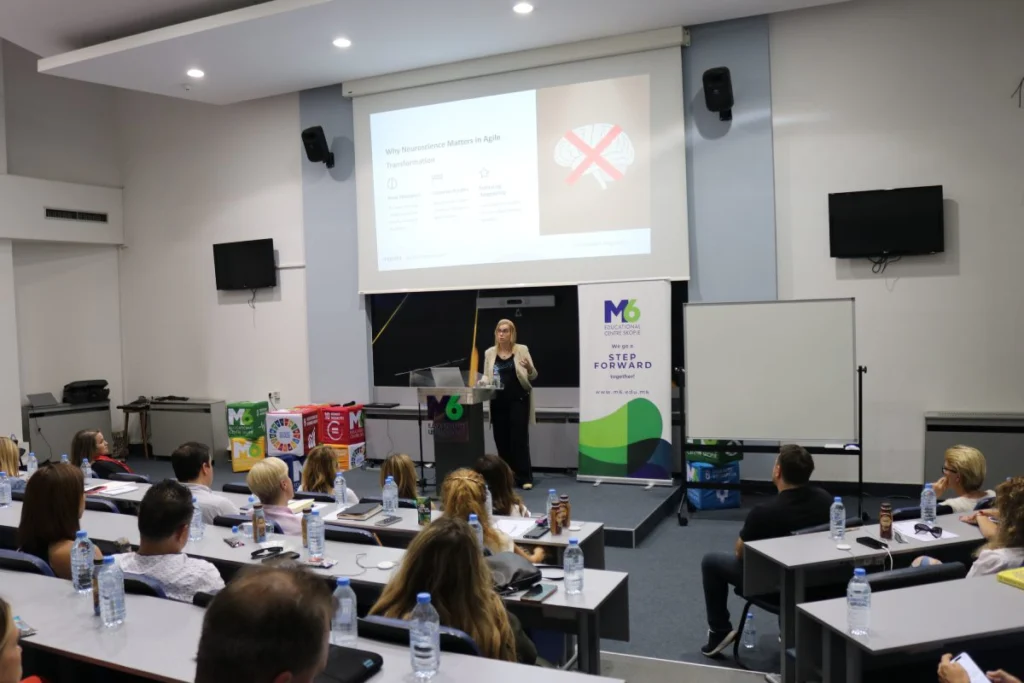
On June 18, 2025, the conference “Decisions, Decisions: Neuroscience and the Future of Leadership” was held, organized by the M6 Educational Center. The event successfully brought together what is rarely found in one place – deep scientific knowledge and practical application for the business of the future.
This conference is part of the platform for positive social transformation “Step Forward”, which M6 has been leading for the past few years. Through education and expert advice, it contributes to proposing solutions that impact the development of individuals, organizations, and society.
The event gathered more than 100 experts in the fields of neuroleadership, medicine, consulting, corporate development, and academia. International speakers, along with representatives from leading companies, explored essential questions for every modern leader: How does the human brain think? How are decisions made under stress and uncertainty? And what does it mean to lead people with understanding rather than authority?
The keynote speaker at the conference was Dr. Nikolaos Dimitriadis, a renowned scientist, university professor, and director of the EY Applied Neuroscience Lab. He is considered one of the pioneers in applying neuroscience to modern leadership and marketing. In his inspiring presentation, Dr. Dimitriadis emphasized that the brain, as the most complex organ in the human body, is a key instrument in the decision-making process. According to him, true leadership must be based on a deep understanding of neurological processes that drive human thought, emotion, and behavior.
He focused on the latest trends and practical applications of neuroscience in business, which are already being implemented in numerous leading companies to improve leadership, human resource management, well-being, and workplace safety. Through a rich blend of scientific insights and real-world examples, he highlighted the importance of developing a new, neuro-informed approach to leadership – one that is thoughtful, resilient to stress and uncertainty, and aligned with people’s psychological and emotional needs.
Among the notable speakers was Vesna Kuzmanović, founder of the Macedonian company IMPALA Research. She presented her revolutionary approach to interpreting people’s unconscious reactions using a DIY neuromarketing platform – the first of its kind in the region. Based on state-of-the-art eye-tracking technology and biometric tools, this platform enables precise measurement of visual perception, emotional responses, and physiological reactions. According to Kuzmanović, understanding human behavior in this way is crucial for quality decision-making in management, marketing, and leadership.
Additionally, Prof. Ежени Брзовска, a marketing professor at the Faculty of Economics at the University “St. Cyril and Methodius,” presented research linking neuroscience with modern marketing strategies. Her presentation sparked significant discussion about how neuroscience and consumers’ visual habits should be integrated into the future of retail, based on deeper insights into human perception.
In the practical segment of the conference, emotional intelligence experts Natascha Ivanovska and Biljana Velevska led an interactive session dedicated to developing emotional intelligence in leaders. They analyzed how social signals affect productivity and the psychological safety of teams.
The final part of the conference focused on real-world case studies of Macedonian companies that have successfully integrated neuroscience tools into their daily operations. The “Tikveš” wine cellar shared insights into how they used neuromarketing methodologies to redesign their “Alexandria Premium Cuvée” line. Based on emotional and visual reaction analysis, they selected a design that resonates most with consumers, fostering a stronger brand connection and higher market recognition.
“Телма ТВ” demonstrated how neuro-analysis of viewer reactions helped them identify audience preferences. These findings were used to optimize programming schedules and media placement to achieve more effective market positioning.
The conference concluded with a powerful message: the future of leadership and business lies in a deeper understanding of the human mind. In an environment filled with knowledge, experience, and visionary thinking, participants left with a renewed perspective – that the greatest resources of any organization are not machines, processes, or technology, but people and their cognitive and emotional potential.